Quality Control
The “Quality Control” page contains data on the calculation of operational characteristics allowing to evaluate: diagnostic sensitivity and diagnostic specificity — the predictive value of positive and negative results, as well as diagnostic efficiency — the likelihood ratio of positive and negative results.
To go to the “Quality Control” page, click on the corresponding item in the main menu.
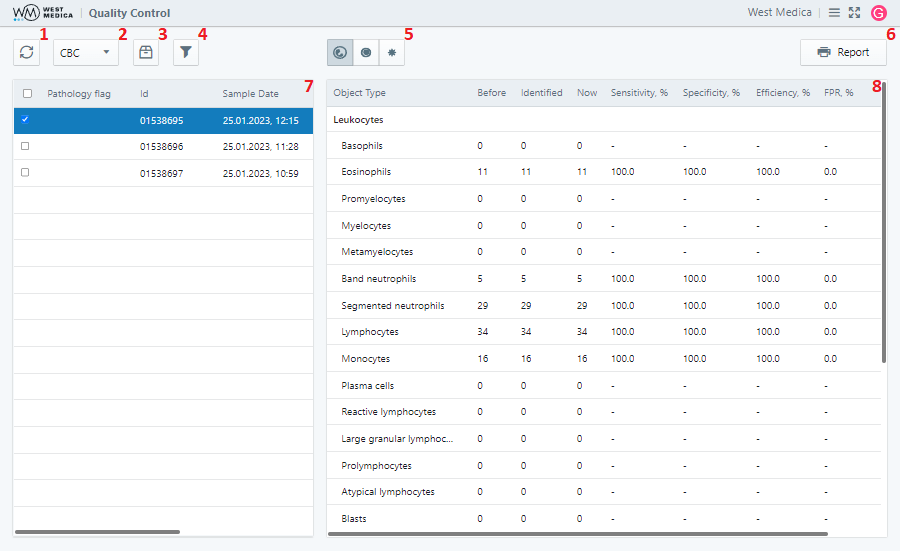
The “Quality Control” page consists of the following items:
- “Refresh” — refreshes the table of sample;
- Drop-down list with sorting options by sample type: “CBC”, “BM”, ”BF”, ”Pap”, ”Pap ICC”, “STDs”, “Gram”;
- “Show archived samples” button — enables/disables the display of samples from the archive;
- “Filter” button — adds sample filters:
- “Pathology flag” — filtering by pathology flag;
- “ID” — filtering by ID;
- “Sample Date” — filtering by collection date;
- “Sample Scanning Date” — filtering by sample scanning date;
- “Validation Date” — filtering by sample validation date;
- “Note” — filtering by comments;
- Quality control tab switching panel — buttons for switching quality control tabs, the set of tabs depends on the type of sample selected;
- “Export” — exporting results for the selected samples in csv format:
- “Pre-classification results”;
- “Validation results”;
- “Report” button — displays the quality control report for the samples selected in the table;
- Table of samples — allows selecting samples to display data and compile a report;
- Table of results — displays data on the selected sample:
- Quality control by cells/objects (available for CBC, BM, BF, Pap, Pap ICC, STDs samples):
- “Object Type” — types of objects;
- “Before” — initial number of objects;
- “Identified” — number of correctly identified objects;
- “Now” — number of objects after validation;
- “Sensitivity” — diagnostic sensitivity;
- “Specificity” — diagnostic specificity;
- “Efficiency” — diagnostic efficiency;
- “FPR” — proportion of false positives;
- “FNR” — proportion of false negatives.
- Quality control by flags (available for Gram samples):
- “Object Type” — flags of the sample;
- “Before” — original flag values;
- “Now” — flag values after validation;
- “Accuracy” — accuracy of flag detection;
- Quality control by samples (available for Gram samples):
- “Total” — total number of cells;
- “Correct” — number of samples in which each flag was detected with non-zero accuracy;
- “Incorrect” — number of samples in which at least one flag was detected with zero accuracy;
- “Accuracy”;
- Quality control by Pathology/Norm sample distribution (available for Pap, Pap ICC, STDs, PW samples):
- TP (True Positive) — there is at least one pathological element correctly identified as pathological;
- FP (False Positive) — there is at least one non-pathological element incorrectly identified as pathological;
- TN (True Negative) — non-pathological elements are identified correctly; pathological elements are absent;
- FN (False Negative) — pathological elements are identified incorrectly; pathological elements are present;
- DSn — diagnostic sensitivity;
- DSp— diagnostic specificity.
- Quality control by cells/objects (available for CBC, BM, BF, Pap, Pap ICC, STDs samples):